


Last Updated: November 2, 2026
Quick Summary
Science backed ingredients are active compounds such as retinoids, vitamin C, peptides, and bakuchiol whose effects on skin aging have been examined in published research rather than inferred from marketing. We recommend choosing ingredients that calm and rebuild the barrier first, then adding one resurfacing active only when skin is stable.
- A 2023 review reports that 3% retinol is effective for treating skin aging, though it does not detail sample sizes for every formulation.
- Bakuchiol does not convert to retinoic acid, which is why it is generally gentler than retinol.
- Expect fine lines and wrinkle appearance to change at eight to twelve weeks and beyond.
- Layering multiple exfoliating acids with a retinoid is the fastest way to wreck a compromised barrier.
- Essential Mist combines aloe, chamomile, green tea, and minerals in a calming spray to refresh the skin.
Table of Contents
- Why Science Backed Ingredients Matter for Aging Skin
- Bakuchiol vs Retinol: Which Belongs in Your Routine?
- Skincare Ingredients for Menopausal Skin That Calm and Rebuild
- How to Build a Simple Anti-Aging Skincare Routine
- How Long Science Backed Ingredients Take to Show Results
- Common Mistakes That Undo Good Ingredients
- Choosing Your Essential Glow and Essential Mist Routine
- Frequently Asked Questions
Why Science Backed Ingredients Matter for Aging Skin
The anti-aging products market reached $55.6 billion in 2025 and is projected to hit $59.3 billion in 2026, according to Grand View Research's anti-aging market analysis. That spending buys a lot of promises. Science backed ingredients for aging skin are different: they are actives with published research behind them, used at concentrations where that research actually applies.
At Dr. Noor Essentials, we formulate around that principle. Physician-formulated skincare starts with what the evidence supports, then strips away everything that does not earn its place.
Science backed ingredients are active compounds, such as retinoids, vitamin C, peptides, and bakuchiol, whose effects on skin aging have been examined in published research rather than inferred from marketing. The distinction matters most after 40, when declining estrogen accelerates collagen loss, skin barrier function weakens, and fine lines, dark spots, and uneven skin tone appear faster.
Here is what most guides get wrong: they list ingredients without grading the evidence or explaining concentrations. Below, we cover the actives worth your money, how they compare, and how to sequence them without triggering the irritation that menopausal skin is prone to.
Bakuchiol vs Retinol: Which Belongs in Your Routine?
Bakuchiol is a plant-derived active often called nature's retinol. It supports skin renewal and helps soften the look of fine lines and wrinkles, but it does so without the irritation, peeling, and redness that retinol commonly causes. That difference is not cosmetic. For skin that has become dry, reactive, or thinning with age, tolerability is the whole game.
Retinol has the stronger evidence base. A 2023 review indexed in PubMed Central reports that 3% retinol is effective for treating skin aging, though the same review does not detail sample sizes or results for every formulation (Research Progress on Skin Aging and Active Ingredients(https://pmc.ncbi.nlm.nih.gov/articles/PMC10385838/)). That is a real endorsement, and a real limit.
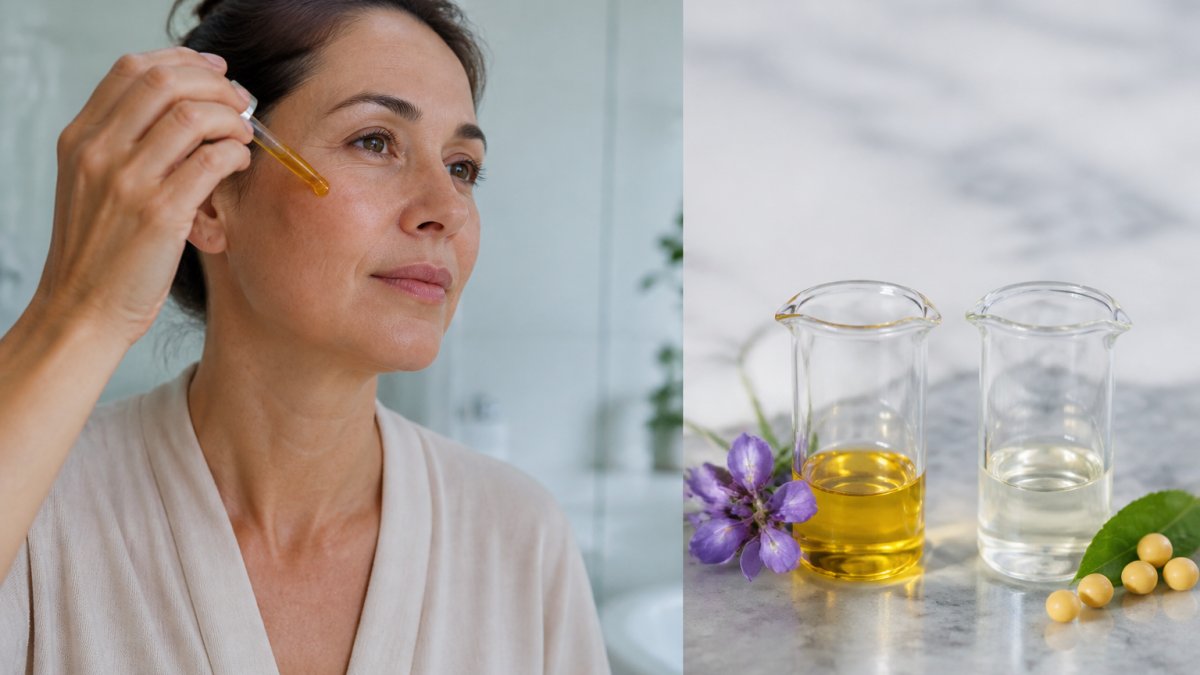
Bakuchiol's evidence is smaller but consistent in direction. Bakuchiol is generally described as better tolerated than retinol, though the studies are fewer and often shorter. The studies are fewer and often shorter than retinol's, so the honest summary is this: bakuchiol is well tolerated and shows real, measurable benefit, but it does not yet have retinol's decades of clinical weight.
Mechanistically, the two are not identical. Retinol converts in skin to retinoic acid, which binds retinoid receptors and accelerates cell turnover and collagen production, a powerful effect that also disrupts the barrier during adjustment. Bakuchiol does not convert to retinoic acid, which is why it is generally gentler than retinol.
For perimenopausal and menopausal skin, the calculus shifts. That is why our Essential Glow oil serum is built on bakuchiol, paired with squalane for hydration, CoQ10 as an antioxidant, and cloudberry oil, an arctic berry and natural source of vitamin C.
| Feature | Bakuchiol | Retinol |
|---|---|---|
| Mechanism | Modulates gene expression without converting to retinoic acid | Converts to retinoic acid; binds retinoid receptors |
| Irritation risk | Low | Moderate to high, especially during adjustment |
| Best for | Sensitive, menopausal skin | Tolerant, non-reactive skin |
| Use with acids | Generally compatible | Needs careful sequencing |
| Evidence base | Growing; smaller human trials | Well established; larger and longer trials |
| Typical concentration | 0.5% to 2% in leave-on products | 0.1% to 1% in cosmetics; 3% studied |
| Onset of visible change | Eight to twelve weeks | Eight to twelve weeks, often with a purge phase |
Best for: reactive skin that has failed retinol before. Skip if: you want the deepest evidence-backed remodeling and your skin tolerates retinoids well. Watch out: do not assume "natural" means risk-free, patch test any new active for a week before daily use, and never layer bakuchiol with a prescription retinoid without guidance.
Skincare Ingredients for Menopausal Skin That Calm and Rebuild
Menopausal skin needs two jobs done at once: calming the irritation that comes with hormonal shifts, and rebuilding the moisture barrier that keeps skin resilient. Ingredients that do both, without a long adjustment period, are the ones worth keeping.
The mechanism starts with estrogen. Estrogen supports sebum production, barrier lipids, and collagen synthesis. As it declines through perimenopause and menopause, skin loses water more easily, produces less oil, and becomes more reactive to products it once tolerated. That is why an active that worked at 35 can sting at 50, the barrier has less margin for error, not because the ingredient changed.
Aloe, chamomile, and green tea are the classic calming trio. Aloe, chamomile, and green tea are commonly used for calming skin. Minerals help skin hold onto water. Our Essential Mist combines aloe, chamomile, green tea, and minerals in a calming spray to refresh the skin. For a fuller step-by-step approach to this skin stage, our guide to a skincare routine for perimenopausal skin walks through it from cleansing to actives.
The rebuilding side is where humectants and emollients earn their keep. Squalane supports hydration, and CoQ10 is included as an antioxidant. Cloudberry oil, an arctic berry and natural source of vitamin C, adds both antioxidant support and emollience. The distinction that matters: humectants pull water in, emollients seal it, and antioxidants protect what is already there. Menopausal skin usually needs all three, which is why a serum-moisturizer hybrid like Essential Glow covers more ground with fewer steps.
Industry reporting for 2026 points to a broader shift toward "stronger yet gentler" formulations, with stabilized forms of vitamin C and better-tolerated retinoids leading the way (Allure's 2026 skincare trend report(https://www.allure.com/story/skin-care-trends-2026)). The takeaway for this life stage is simple: choose ingredients that calm and rebuild first, then add one resurfacing active only when the barrier is stable. Watch out: if skin stings on contact with products that used to feel fine, that is a barrier signal, pause actives and rebuild with calming, hydrating steps before resuming.
How to Build a Simple Anti-Aging Skincare Routine
A simple anti-aging routine beats a complicated one, because consistency is what drives results and most people abandon ten-step regimens within weeks. Fewer, purposeful products used daily outperform a crowded shelf used sporadically.
Here is the sequence we recommend:
- Cleanse gently. A non-stripping cleanser morning and night.
- Treat with one active. Bakuchiol or retinol, not both at once.
- Hydrate and seal. A serum-moisturizer hybrid or a dedicated moisturizer.
- Protect every morning. Broad-spectrum mineral sunscreen, reapplied as needed.
- Calm as needed. A mist for tightness or midday stress.
That is it. If you want the mature-skin version in more detail, our minimalist routine guide for mature skin expands each step.
Watch out: layering multiple exfoliating acids and a retinoid in the same routine is the fastest way to wreck a compromised barrier. Pick one resurfacing active and let it work.
How Long Science Backed Ingredients Take to Show Results
Science backed ingredients take time, and the timeline depends on the active. Expect results to take time, with hydration and comfort often noticed before changes in fine lines and dark spots.
- Hydration and calm: days to two weeks
- Skin texture and tone: four to eight weeks
- Fine lines and wrinkle appearance: eight to twelve weeks and beyond
- Dark spots and uneven skin tone: three months or more
The 2023 review's efficacy claim for 3% retinol does not come with a stated timeline or sample size, so treat any precise promise with suspicion (Research Progress on Skin Aging and Active Ingredients(https://pmc.ncbi.nlm.nih.gov/articles/PMC10385838/)). Consistency beats intensity. A product used daily for twelve weeks will outperform a stronger one used twice a week.
Common Mistakes That Undo Good Ingredients
Good ingredients fail for boring reasons. Most often, the routine around them is working against them.
- Skipping sunscreen. UV damage undoes collagen support faster than any active can rebuild it.
- Over-exfoliating. Glycolic, lactic, and mandelic acid all help, but daily use alongside a retinoid is too much for most sensitive skin.
- Starting at full strength. Ramp up slowly, especially with vitamin A.
- Mixing incompatible actives. Some antioxidants and acids destabilize each other when layered back to back.
- Quitting at week three. Skin renewal is slow. Most people stop right before results appear.
A common mistake is buying more products instead of using the right ones consistently. Two well-chosen products, used daily, will do more than eight used occasionally.
Choosing Your Essential Glow and Essential Mist Routine
The simplest way to put science backed ingredients to work is to pair a treatment with a calming step. Essential Glow handles resurfacing and hydration in one oil serum. Essential Mist handles calm and refreshment.
Neither is medical grade skincare, and we do not position them as such. They are minimalist formulas designed for skin that has become pickier with age. One customer, Janet, an Essential Glow customer, put it plainly: "My skin feels noticeably smoother, more hydrated, and has a glow I haven't been able to achieve with other products."
If you want both in one ritual, our Everyday Essentials duo pairs the mist and the serum. If you are still deciding, start with the serum and add the mist for midday calm.
Aging skin does not need more products. It needs the right ones, used consistently, with ingredients that respect a barrier that has less margin for error than it did at 30. Dr. Noor Essentials builds around that idea: physician-formulated, science-first, and intentionally minimal, with bakuchiol, squalane, CoQ10, and cloudberry oil doing the heavy lifting in Essential Glow, and aloe, chamomile, and green tea calming skin in Essential Mist. Get started with Dr. Noor Essentials and give your routine fewer steps and better ingredients.
Frequently Asked Questions
Is bakuchiol as effective as retinol for fine lines?
Bakuchiol is often called nature's retinol because it supports skin renewal and helps soften the look of fine lines without the irritation retinol can cause. Bakuchiol works differently from retinol and is generally considered gentler, so it may suit sensitive or menopausal skin.
Can bakuchiol be a gentler option for sensitive or menopausal skin?
Yes. Bakuchiol is plant-derived and is generally considered gentler than retinol, which can matter as skin becomes more reactive with perimenopause and menopause. A minimalist formula that pairs bakuchiol with squalane, CoQ10, and cloudberry oil supports hydration and antioxidant defense at the same time. If your skin has become pickier in your forties or fifties, bakuchiol is a practical starting point.
Can you use bakuchiol with vitamin C?
Yes, bakuchiol and vitamin C can be used together. Vitamin C is an antioxidant that helps with uneven skin tone and dullness, while bakuchiol supports skin renewal. A simple approach is to use a vitamin C-rich product in the morning and a bakuchiol serum in the evening, or choose a formula that already combines them. Cloudberry oil, an arctic berry rich in vitamin C, is one example of a plant-derived source.
What skincare ingredients help hydrate aging skin?
Squalane is included in Essential Glow for hydration. For menopausal skin, layering a hydrating serum with a moisturizer helps reduce tightness and dullness. A calming mist with aloe, chamomile, and green tea can refresh skin during the day and prepare it for the next step in your routine.
How long does it take to see results from anti-aging skincare ingredients?
Timelines vary by ingredient and by person. Results vary by person and product. Consistent daily use gives a routine time to show whether it suits your skin. Take a photo every two weeks to track changes.
What is a simple skincare routine for aging, sensitive skin?
Keep it to three steps in the morning and three at night. Morning: a gentle cleanser, a calming mist, and a moisturizer with antioxidants. Night: cleanse, apply a bakuchiol oil serum like Essential Glow, and use the mist if skin feels tight. This minimalist approach keeps the routine simple and easier to stay consistent with. Fewer, purposeful products often work better than a long list of actives.


